Hill walking is the most underestimated fitness activity in Ireland and the most accessible serious one. A four-hour walk in the Wicklow Mountains with 600 metres of elevation gain builds real leg strength, burns more calories than most gym sessions, and develops cardiovascular fitness that holds up in the real world. It also costs nothing beyond the fuel to get there. The gym has its place, but for a significant portion of the population, a weekly hill would serve them better.
Ireland is exceptionally well-placed for this. The Wicklow Mountains are 45 minutes from Dublin city centre. Every province has accessible upland terrain within an hour of its major population centres. The trail network is well-maintained, the Coillte forest routes are free and regularly updated, and the terrain variety — from gentle forest paths to serious ridge scrambles — means there is an appropriate challenge for every fitness level.
What Hill Walking Actually Does to Your Body
Elevation is the key variable. Walking uphill — particularly on sustained gradients of 10% or more — drives glute and hamstring activation at an intensity that flat walking never achieves. The cardiovascular demand rises quickly on ascent and stays elevated. Descent is equally demanding in a different way: the eccentric loading on quads on the way down builds strength and resilience that gym leg work rarely replicates, because the angles and loading patterns are genuinely different.
Over a full day's walking with meaningful elevation, calorie burn is comparable to running the same horizontal distance. The joint stress is a fraction of running, making hill walking accessible to a wider range of people and sustainable across a longer career. People who start hill walking in their forties and fifties often find that their fitness and leg strength improve steadily for years.
The mental health evidence is also substantial. Time in natural environments at moderate physical exertion reduces cortisol, improves mood, and has well-documented effects on anxiety and depression. The combination of physical challenge, navigational focus, and scenery produces a quality of mental restoration that indoor training cannot match. Most regular hill walkers describe it as addictive — the pull back to the hills is real and it builds over time.
Where to Walk — The Best Hill Areas by Province
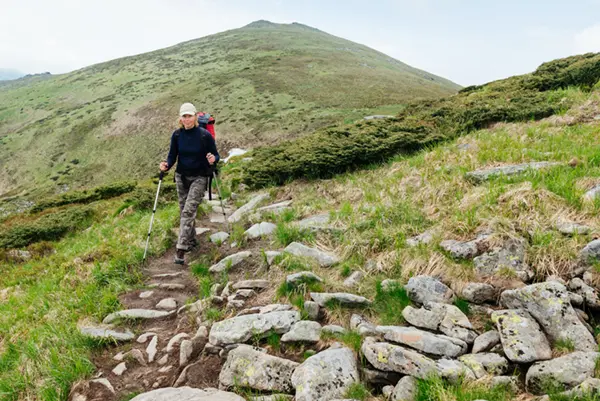
The Wicklow Mountains are the obvious starting point for anyone based in Leinster. Ticknock forest trails are well-marked and gentle enough for complete beginners; the Great Sugar Loaf (501m) is a short, steep classic that rewards the effort with panoramic views; Djouce and War Hill offer longer ridge walks with serious elevation for those ready to push. The Wicklow Way stretches 132km south and provides endless options for half-day or full-day routes.
In Munster, the MacGillycuddy's Reeks in Kerry are the most dramatic terrain in the country — Carrauntoohil (1,040m) is Ireland's highest mountain and a serious undertaking for fit walkers with the right gear. Brandon Mountain on the Dingle Peninsula offers a rewarding coastal ridge walk with considerable elevation. The Galtee Mountains in Tipperary are less-visited and genuinely excellent.
The Mourne Mountains in Down are the outstanding option in Ulster — Slieve Donard (849m) from the sea at Newcastle is one of the finest hill walks in Ireland. The Sperrin Mountains in Tyrone offer gentler terrain for those starting out. In Connacht, the Twelve Bens in Connemara and Croagh Patrick in Mayo are both classics, though Croagh Patrick's scree-covered summit section is demanding regardless of fitness level.
Making It Training — Not Just Walking
If you want to get more fitness value from hill walking, the variables to manipulate are elevation, pace, and frequency. Choosing routes with more ascent per kilometre, walking faster on the flat sections, and reducing rest time at summits all increase the training load. Adding a weighted rucksack — even 5 to 8kg — transforms a hill walk into a rucking session with significant additional demand on the posterior chain.
A once-weekly hill walk done with intention is a meaningful contribution to fitness. Twice weekly with progressive routes builds serious cardiovascular capacity and lower body strength over a season. The people who dismiss hill walking as too easy are typically the people who have not tried to push the pace up a 25% gradient for forty minutes continuously.
Frequently Asked Questions
Yes. A four-hour hill walk with 500 to 700 metres of elevation gain is a serious physical undertaking that burns more calories than most gym sessions and builds genuine leg strength and cardiovascular capacity. Done regularly, hill walking produces real and lasting fitness gains.
The Wicklow Mountains are the most accessible for Dublin-based walkers — Ticknock, the Great Sugar Loaf, and Djouce all offer well-marked routes with managed gradients. The Cooley Peninsula and the Galtee Mountains are excellent options further afield.
Waterproof boots with ankle support are essential on Irish terrain. A packable waterproof jacket, moisture-wicking base layers, and hat and gloves year-round are the minimum. Irish weather changes fast on high ground.
Hill walking with elevation is comparable to running in calorie burn and cardiovascular demand, with significantly lower joint impact. The strength component on ascent and descent is greater than flat running. For people who cannot or do not want to run, it is a genuinely effective alternative.
Fitness Bootcamp Ireland
Practical fitness guides for Irish adults — outdoor training, home workouts, gear reviews and event prep. No gym required.